A full schedule, fewer no-shows, patients who come back.
Booking, reminders, intake, recalls, memberships and the books in one system — built around how your practice actually runs its day, and yours to keep. One fee, once. No monthly platform bill, ever.
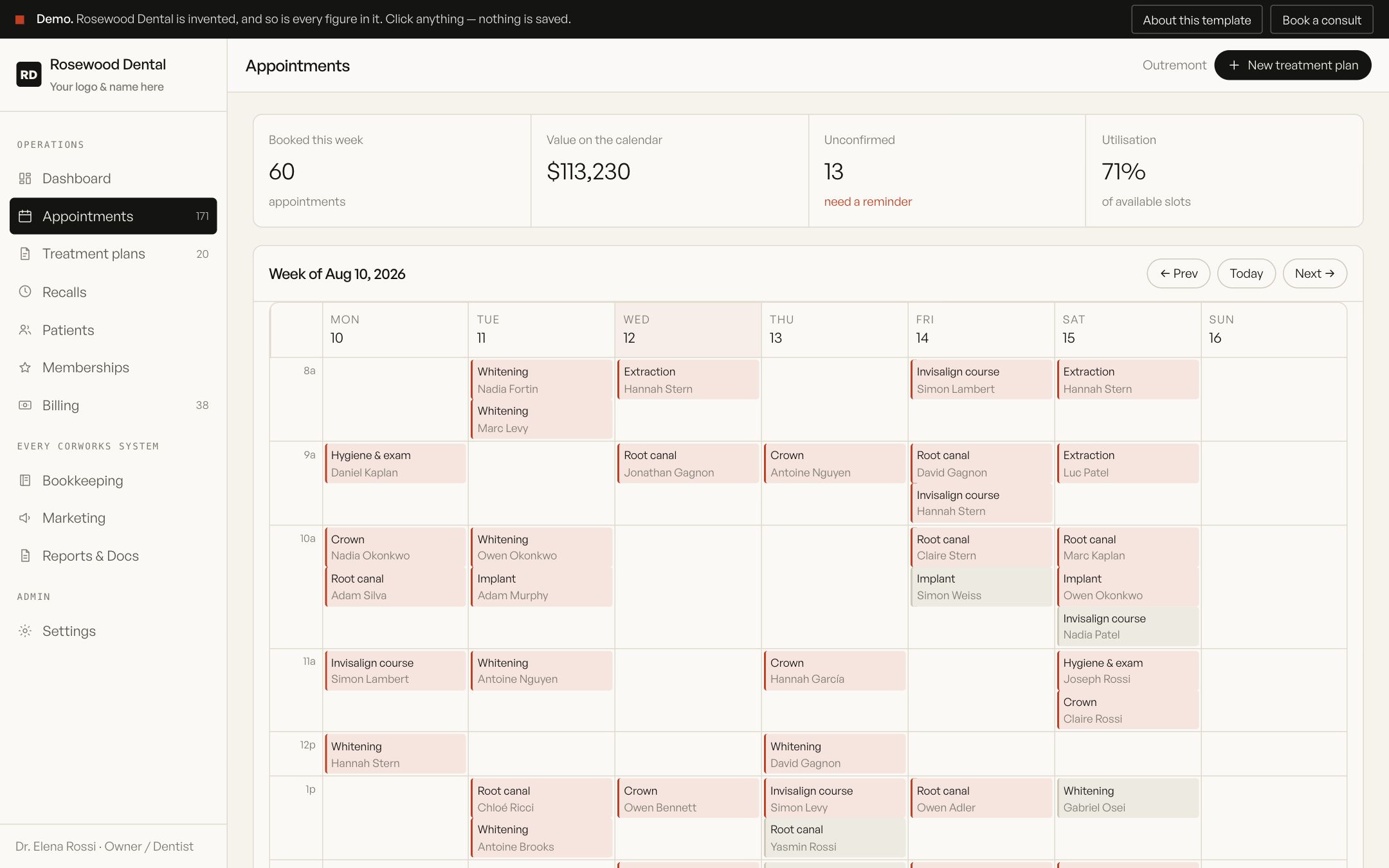 Open the live demo
or $625/mo for 12 months at 0%
The only thing you sell is the schedule.
A gap at two o'clock is revenue that cannot be recovered later, and every practice loses it differently — no-shows in one, recalls nobody sent in another, a waitlist that exists only as a stack of notes at the front desk. Off-the-shelf booking software treats all three as the same problem, which is why practices end up running their real cancellation policy manually, on top of the software they pay for.
We build to your day: your practitioners, your service durations, your deposit rules, your recall intervals. The schedule defends itself.
The four questions everyone asks us.
“Is it actually cheaper?”
Inside 11 months, yes — and it keeps being cheaper every year after. A practice paying $700 a month for the tools above spends $42,000 over five years. Owning the same thing costs $7,500 once.
Two recovered no-shows a week is usually a larger number than the software bill ever was.
“What about the bookkeeping?”
Visits, memberships, packages and deposits post to the books as they happen, against a chart of accounts built for a practice. Prepaid packages are carried as deferred revenue and drawn down as they are used, so a good month is not overstated.
Production per practitioner and revenue per hour are live numbers rather than a month-end exercise.
“Will it fit how we run?”
That is the whole point. Your practitioners, your service list and durations, your deposit and cancellation policy, your recall intervals, your intake questions. We build to your day rather than to a national platform's idea of one.
If you need something no software has, we build it. It is yours.
“What about patient data and privacy?”
Patient data is handled under the rules that apply where you practise — HIPAA in the United States, PIPEDA and provincial law in Canada. We scope what the system stores and what it deliberately does not, and where an EMR must remain the record of care, we connect to it rather than replace it.
It lives on your own hosting, under your control, not a vendor's.
Your pipeline, on one board.
Every record moves through these stages and the system knows what should happen at each one. Stage names and rules are changed to match how you talk about the work.
Online booking & intake
Real availability by practitioner and service, with intake forms and consent completed before arrival.
Reminders & confirmations
Email and SMS at the intervals that actually reduce no-shows, with one-tap confirm or reschedule.
No-show deposits & policy
Card on file and a stated policy on the slots you cannot afford to lose.
Recall & reactivation
Six-month cleanings, annual checks, lapsed patients — the recall list runs itself instead of living in someone's memory.
Waitlist auto-fill
A cancellation texts the waitlist and fills the slot before you notice it opened.
Memberships & packages
Monthly memberships, session packs and prepaid plans, with balances visible at the front desk.
And Treatment plans & follow-through · Practitioner performance · Insurance & receipts · Referral program · Chair / room utilization · Reputation engine
Patient data is handled under the privacy rules that apply where you practise — HIPAA in the United States, PIPEDA and provincial law in Canada. We scope what the system stores, and what it deliberately does not.
What happens without anyone touching it.
The numbers you get to watch.
| Measure | Read as |
|---|---|
| Chair or room utilization | The real capacity number |
| No-show and cancellation rate | Before and after deposits |
| Rebooking rate | Patients leaving with the next visit booked |
| Patient lifetime value | By acquisition source |
Click through it before you talk to anyone.
A working system for an invented practice, on invented but consistent numbers. Open the pipeline, the jobs, the invoices, the reports — all of it responds.
The website, the Google Ads, the local SEO and the bookkeeping can be part of the same engagement — see what that includes.
Tell us how your business runs.
One free hour, no obligation, and you keep the written plan either way. We reply within one business day.