Quote fast, schedule tight, get paid on time.
Quoting, scheduling, dispatch, follow-up and the books in one system — built around how your crews actually work, and yours to keep. One fee, once. No monthly platform bill, ever.
 Open the live demo
or $625/mo for 12 months at 0%
Nobody prices a job the way you do.
Every trade we have built for prices differently — per square foot, per opening, per hour with a minimum, per unit plus a travel charge, or a number the owner has in their head and has never written down. Software that cannot hold your pricing makes you quote twice: once in the system, once properly. So we start by learning yours, and the quote builder does the arithmetic your way.
The same goes for your stages, your paperwork and the words on every screen. You should not have to translate your business into someone else's product.
The four questions everyone asks us.
“Is it actually cheaper?”
Inside 11 months, yes — and then it keeps being cheaper for every year after. A shop paying $700 a month for the tools above spends $42,000 over five years. Owning the same thing costs $7,500 once.
If you run one $50-a-month tool and nothing else, we will tell you honestly that you are not our client yet.
“What about the bookkeeping?”
Every quote, deposit, invoice and payment lands in the books as it happens, categorised against a chart of accounts built for a trade. Job costing is real: materials and labour hit the job they belong to, so margin is a number rather than a feeling.
Sales tax is prepared as you go, not reconstructed in April.
“Will it fit how we work?”
That is the whole point. We spend the first hour learning how the work actually moves — your pricing, your crews, your stages, the paperwork your inspector wants — and build to that. It is not a product you adapt to.
If you need something no software has, we build it. It is yours.
“What if you disappear?”
You hold the code, the data and the accounts, in your name, on your own hosting. It keeps running whether or not we exist, and any competent developer can pick it up.
Nobody who rents you software can say that.
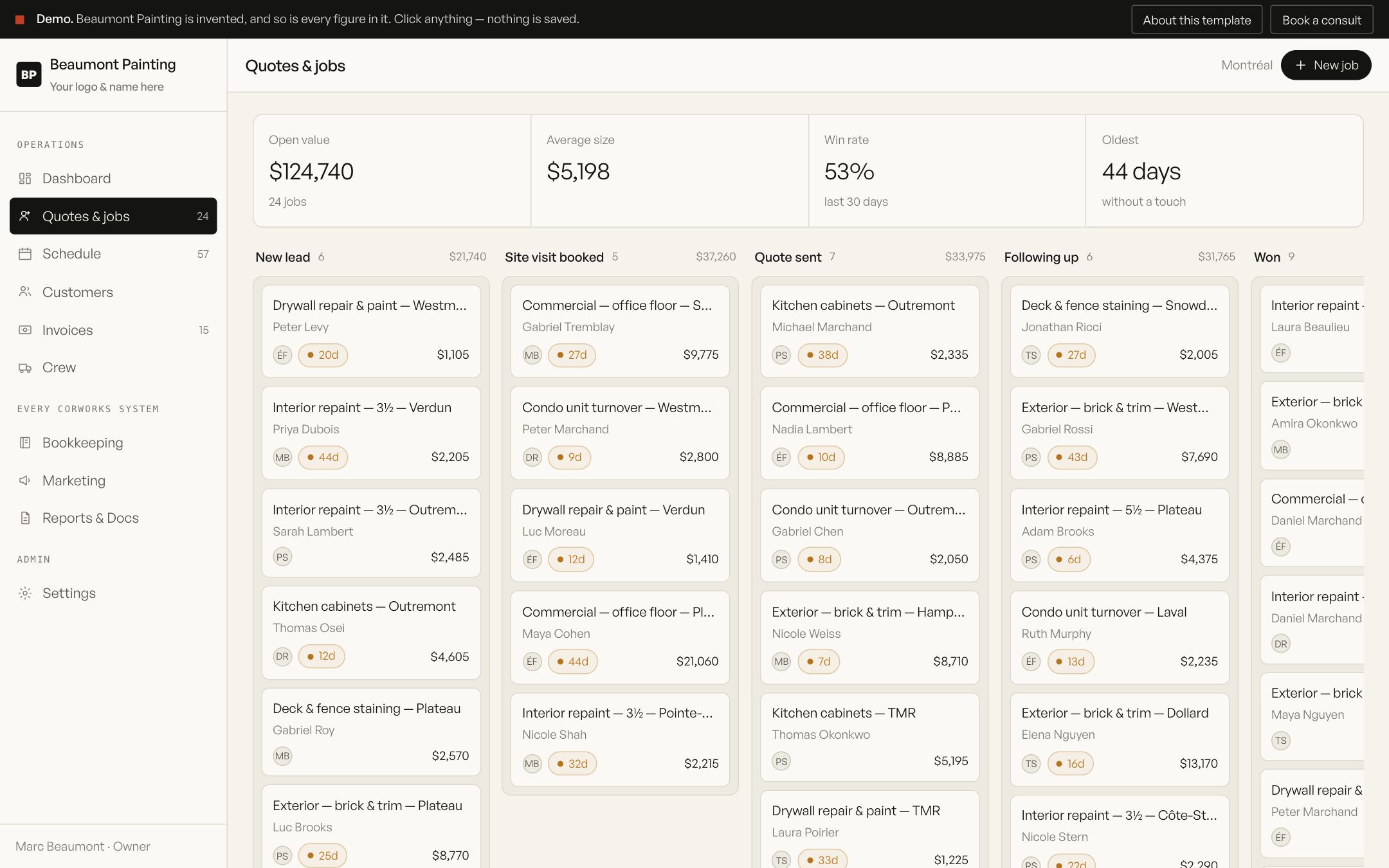
Your pipeline, on one board.
Every record moves through these stages and the system knows what should happen at each one. Stage names and rules are changed to match how you talk about the work.
Quote builder with your pricing
Per-surface, per-hour or per-unit rates built in. Pick the work, the price is right — including materials, labour and markup.
Internal margin view
Every quote shows what it costs you and what you keep, before you send it. Never bid a job blind again.
Job scheduling & dispatch
Drag jobs onto a calendar, assign a crew, and the crew sees only what they need on their phone.
Site photos & notes
Before, during and after photos attached to the job, stamped and searchable. Ends disputes.
Deposits & payment links
Take a deposit when the quote is accepted, and the balance on completion, with a link that works on a phone.
Automatic follow-up
Quote unanswered after two days? The system emails. After five? It texts. You do nothing.
And Contact-attempt tracking · Missed-call text-back · Materials & supplier costs · Change orders · Warranty & callback log · Seasonal reactivation · Review requests · Crew payroll & commission
What happens without anyone touching it.
The numbers you get to watch.
| Measure | Read as |
|---|---|
| Quote-to-close rate | By service, by crew, by lead source |
| Cost per booked job | Ad spend against jobs actually signed |
| Average job margin | After real materials and labour |
| Speed to first contact | Minutes from lead to first reply |
Click through it before you talk to anyone.
A working system for an invented trades business, on invented but consistent numbers. Open the pipeline, the jobs, the invoices, the reports — all of it responds.
The website, the Google Ads, the local SEO and the bookkeeping can be part of the same engagement — see what that includes.
Tell us how your business runs.
One free hour, no obligation, and you keep the written plan either way. We reply within one business day.