Proposals that win, projects that stay inside their scope.
Proposals, scope, approvals, time and the books in one system — shaped around how your practice actually sells and delivers, and yours to keep. One fee, once. No monthly platform bill, ever.
 Open the live demo
or $625/mo for 12 months at 0%
Your scope is the product. It should not live in a Word file.
Interior designers bill on selections and markup. Lawyers bill on matters and trust. Accountants bill on a season. Consultants bill on a retainer that quietly turns into twice the work. Generic project software flattens all of that into tasks and due dates, which is why the profitable part of the job — what was scoped, what was approved, what was extra — ends up in someone's inbox instead.
We build the proposal, the approval trail and the clock around the way you actually sell. Round three becomes billable because everyone can see it is round three.
The four questions everyone asks us.
“Is it actually cheaper?”
Inside 17 months, yes — and it keeps being cheaper every year after. A practice paying $450 a month for the tools above spends $27,000 over five years. Owning the same thing costs $7,500 once.
The larger saving is usually not the software. It is the hours you currently write off because nobody logged them against a phase.
“What about the bookkeeping?”
Fees, retainers, milestones and disbursements post to the books as they are billed, against a chart of accounts built for a practice. Project profitability is live: fees against hours and hard costs, per project and per client, while the work is still in progress.
You find out a project is underwater in week three rather than at year end.
“Will it fit how we work?”
That is the whole point. We spend the first hour on how you scope, quote, approve and bill — your phases, your fee structure, your revision policy, your language for all of it — and build to that. It is not a product you adapt to.
If you need something no software has, we build it. It is yours.
“What if you disappear?”
You hold the code, the data and the accounts, in your name, on your own hosting. Client files, contracts and history stay yours, and any competent developer can maintain it.
That matters more in a practice than most places — your obligations to a client outlive any vendor.
Your pipeline, on one board.
Every record moves through these stages and the system knows what should happen at each one. Stage names and rules are changed to match how you talk about the work.
Proposal & scope builder
Reusable scope blocks, phased fees and options the client can accept online. Signed digitally, filed automatically.
Retainer & milestone billing
Bill on signature, on milestone, or monthly — with the schedule generated when the proposal is accepted.
Client portal
One link where the client finds deliverables, approvals, invoices and the current stage. Cuts status emails to near zero.
Approval & revision tracking
Every concept, drawing or draft carries an approval state and a revision count. Round three is billable and everyone can see why.
Time tracking against scope
Hours land on the phase they belong to, with a live read on whether the project is still profitable.
Document & e-signature
Contracts, NDAs and change orders signed in the browser, versioned, and stored on the project.
And Specification & selection sheets · Vendor & trade coordination · Project profitability · Referral & past-client nurture · Portfolio pipeline · Intake questionnaire
What happens without anyone touching it.
The numbers you get to watch.
| Measure | Read as |
|---|---|
| Proposal win rate | By service line and by fee size |
| Effective hourly rate | Fees divided by hours actually spent |
| Scope variance | Billed hours against quoted hours |
| Revenue per client | Including repeat and referral work |
Click through it before you talk to anyone.
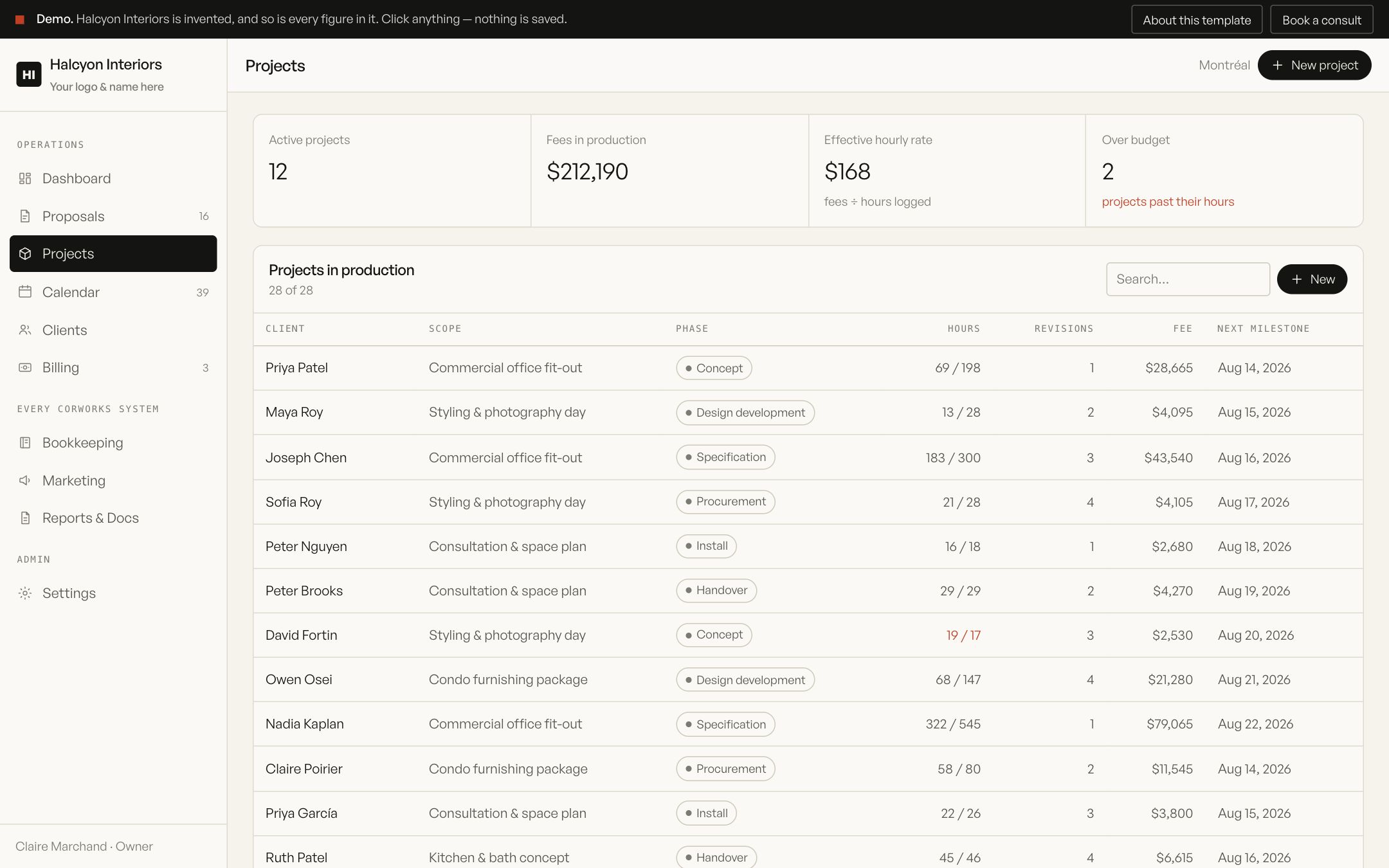
A working system for an invented small practice, on invented but consistent numbers. Open the pipeline, the jobs, the invoices, the reports — all of it responds.
The website, the Google Ads, the local SEO and the bookkeeping can be part of the same engagement — see what that includes.
Tell us how your business runs.
One free hour, no obligation, and you keep the written plan either way. We reply within one business day.